
Sustainable Travel
Do you know how to travel greener to your mountain tour?
Mountain environments are delicate and complex ecosystems, which are prone to the effects of global warming and rising CO2 levels. We are increasingly witnessing the consequences: alpine routes disappearing; rockfall, landslides and avalanches are ever-increasing; glaciers are retreating; and biodiversity is being lost at a staggering rate. But what can you do to help? Take responsibility for your own actions and adapt your behavior. For outdoor enthusiasts like us, it is clear that we must do everything in our power to protect the natural world – the world in which we are allowed to live out our dreams. In addition to sensible purchasing decisions, behaving respectfully and adapting our behavior in other ways, we can also look at the ways in which we travel.
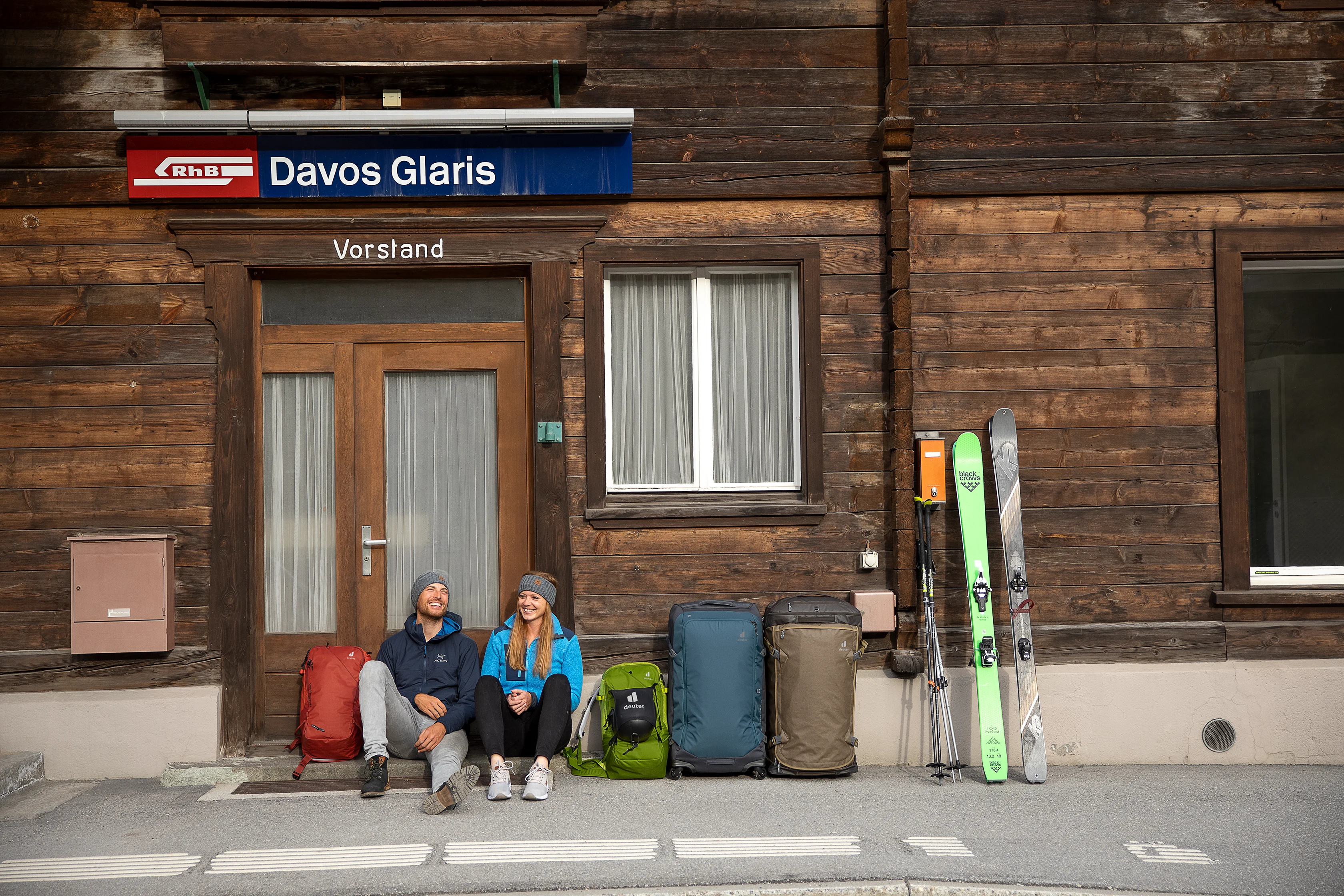
It’s all about cutting CO2
Travel is a sticky subject, since the best way to cut CO2 emissions is to stop traveling altogether. But we often have no choice. So, you should always be conscientious and ask yourself whether you can forego the trip (stay for several days instead of taking multiple trips), adjust (e.g. train instead of car) and/ or compensate for it at the end of the trip (offset through climate projects).
Tips for greener ways of traveling
A travel survey carried out by the DAV (German Alpine Club) concluded that mountain tour travel habits of DAV members are as follows:
- Just 17% use public transport, while over 71% travel by car.
- Average distance to and from a day trip is 144 km, and for multi-day trips 472 km
- Mountain sports enthusiasts undertake 18 day trips, 4 multi-day trips and 1.4 stays of > 7 days on average each year
- This equates to the average DAV member traveling approx. 5,456 km and generating 537.9 kg of CO2 per year
- 82.5% of these emissions come from car travel
Considering that we must keep our emissions down to a maximum of 2 tonnes of CO2 per person per year if we are to achieve the goals set out by the Paris Climate Agreement, then this figure is quite substantial. Emissions from the average car journey to the mountains make up ¼ of our yearly allowance. So how can we reduce that figure?
Using public transportation and carpooling
Travel to our destination generates the most emissions. So this is where changes can also have the greatest impact.
1. Travel together – carpooling
Carpooling is a great way to get to certain areas while also saving gas and CO2. Team up with some friends or check out one of the many ride-sharing websites.
https://www.alpenverein.de/natur-klima/mobilitaet/mitfahrgelegenheiten-in-die-berge_aid_33553.html
2. Travel by public transportation
You’d be surprised how simple and relaxing it is to travel by public transport. These days, there are wide-ranging public transportation networks out there and some areas also offer buses or shuttle services to popular mountain tour destinations.
You can check the specific connections/ times etc. using the service provider’s online app or website.
Throughout the Alps, there are discounted tickets such as Bayernticket, Regioticket or day tickets etc. When traveling greater distances you can often find saver fares or get group discounts.
Here are some websites and providers that will help you plan your travel:
Zuugle:
This site lists all mountain routes in the German-speaking areas of the Alps that can be accessed by train and bus. By the end of 2023, they plan to extend the content to cover France and Slovenia too. https://www.zuugle.de
Bahn zum Berg (mountains by train):
Is the biggest public transport platform for mountain tours in Austria and Bavaria. https://www.bahn-zum-berg.de/
Alpenverein (alpine clubs):
The German, Austrian and Swiss (DAV, ÖAV, SAC) alpine club websites have lots of information on greener ways to travel to the mountains. You’ll find plenty of useful info
- https://www.alpenverein.de/Natur-Klima/Mobilitaet/
- https://www.alpenverein.de/natur-klima/wir-fuers-klima/machs-einfach/oeffentlich-auf-der-letzten-meile_aid_35194.htm
- https://www.alpenverein.at/portal/natur-umwelt/sanfte_mobilitaet/Mobilitaet.php
- https://www.sac-cas.ch/de/umwelt/bergsport-und-umwelt/mobilitaet/
Train websites:
- https://www.bahn.com/en
- https://www.oebb.at/en/
- https://www.sbb.ch/en/home.html
- https://www.thetrainline.com
Transport associations:
- https://www.bayern-fahrplan.de/en/journey-planner?set_language=en
- https://www.vvt.at/page.cfm?vpath=index&switchLocale=en_US
Buses:
No more excuses!
The idea that there are poor or nonexistent public transport links, is an outdated misconception, and one which has now been disproved many times over. This detailed map of public transport links between Lindau (DE) and Salzburg (AUS), Munich (DE) and Brenner (IT) is compelling proof. It was compiled by Michael Vitzthum from Munich and can be requested if interested via dav-panorama@alpenverein.de.
Traveling by public transportation might take a little longer, but it more than makes up for it in terms of sustainability and lack of stress and is a much more sociable option. And if you're in a hurry, well then, you simply got up too late.
Protect our winters

Sustainable mobility is also an important strategic pillar for our partner Protect Our Winters (POW). Together, we are committed to a mobility transition. The focus is on switching to public transport and thus reducing our personal carbon footprint. After all, it is up to each individual to preserve what we all love for future generations.